User Personas
When people think about product management, they often jump straight to roadmaps, features, or sprints. But long before you decide what to build, you need to understand who you’re building for. That’s where User Personas come in.
Table of Contents
Building Better Products Starts with Understanding People!
One of the most overlooked superpowers in Product Management? The ability to listen deeply and map what users feel into what the product does.
So, you want to build a product users actually love?
Start by understanding who you’re building it for. Let’s talk about one of the most underrated yet powerful tools in a product manager’s toolkit: The User Personas.
What are User Personas?
They are semi-fictional characters based on real users that capture key motivations, behaviors, and pain points. Personas are not just design artifacts; they are strategic tools that ensure every product decision serves a real human need.
If you build for everyone, you build for no one
Recently, I created detailed user personas for a Career Builder App that features an AI-powered resume creator. Here’s why it mattered, and how it can help sharpen product direction.
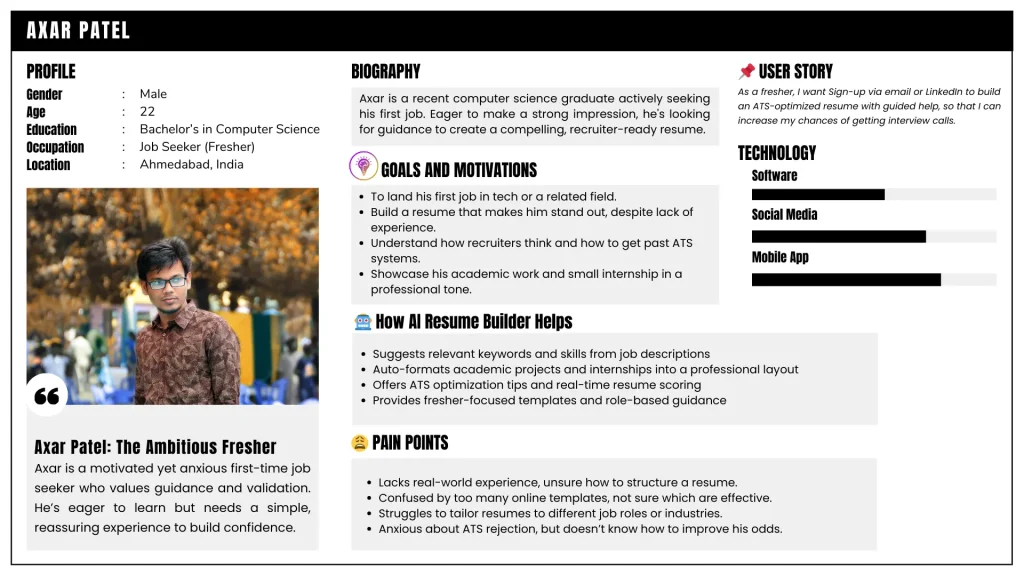
Axar Patel – The Ambitious Fresher
Pain Points: Lacks real-world experience, unsure how to stand out
Needs: Reassurance, structure, and ATS-optimized guidance
Goal: Land his first job in tech by showcasing academic and internship projects
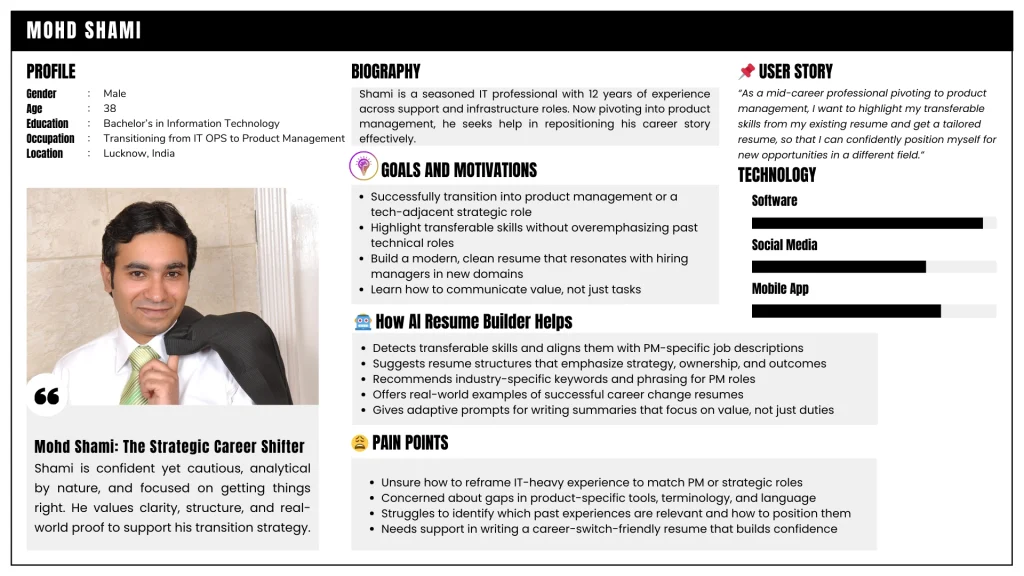
Mohd Shami – The Strategic Career Shifter
Pain Points: Unsure how to reframe IT-heavy experience into PM language
Needs: Clarity on transferable skills and resume storytelling
Goal: Transition into product management without being boxed in by past titles
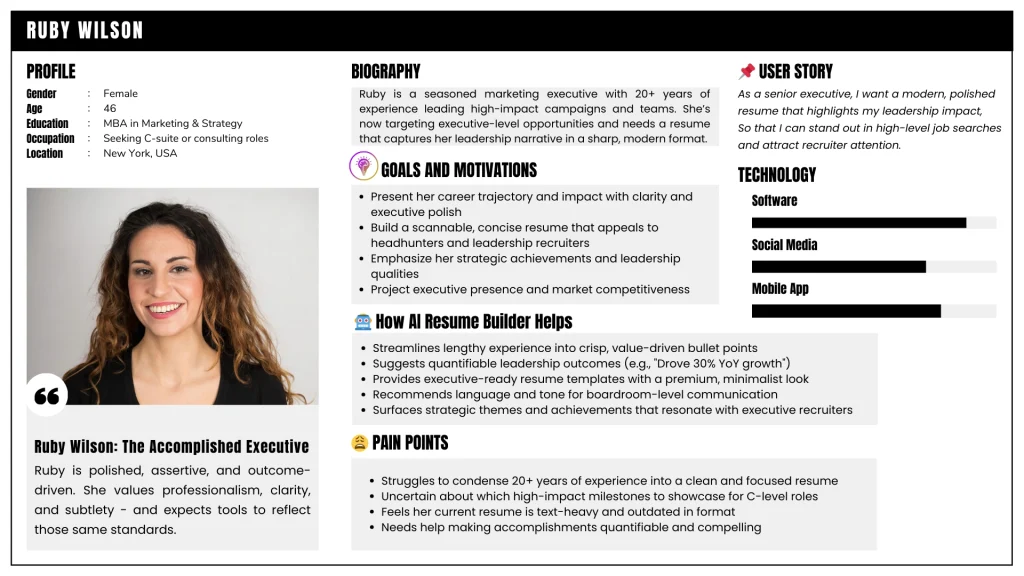
Ruby Wilson – The Accomplished Executive
Pain Points: Overwhelmed by 20+ years of experience; hard to keep it concise
Needs: Executive polish, quantifiable leadership impact
Goal: Secure a C-suite or consulting role by showcasing value, not volume
While creating these personas I tried to cover everything, from template design to content tone to onboarding UX. Because great products are not built for “everyone.” They’re built for someone. Best Practices I Followed While Creating Personas:
- Research-first mindset: I started with real user data, behaviors, and feedback.
- Focused on motivations and goals, not just job titles or age.
- Mapped pain points to product features (e.g., real-time resume scoring, guided formatting tips).
- Ensured they were actionable, informing content, UX, and feature priorities.
These kinds of personas can shape the design, as they aligned the entire team around what mattered most. The experience became:
- Personalized for each career stage.
- Emotionally supportive and confidence-building.
- Functional across diverse user goals, from first jobs to executive pivots.
Final Thought
As a PM, your job isn’t to just ship features. It’s to solve real problems for real people. And to do that well, you need to understand who’s on the other side of the screen. If you’re working in Product, UX, of Development, I’d love to connect and exchange notes on how you approach user research. Let’s build with empathy and intention. Let’s create better tools by starting with better understanding.
Also Read: 4 Steps to Transform User Stories into Success Stories
Related Reading